
Change over time is defined as the time difference of the last product produced and the next new product produced with the right quality and at the right speed.
Production sites with long set-up times are characterized by
If we decrease the set-up times we could use the extra capacity either to increase productivity or to decrease the batch sizes. Typical benefits are:
So how could SMED be effectively implemented?
Based on my experience, the following steps are the key treads that would best guarantee the successful implementation:
Step 1 Focus. Start by choosing the right equipment to start with. This is normally a bottle-neck with long set-up times
Step 2 Build the right team. Work cross-functional. Operators, Technicians, Engineers and Managers should work together
Step 3 – Measure and set goals. Visualize the present situation and agree on a common goal
Step 4 – 5S. To succeed you will need a clean and well organized work-place. A 5S implementation is recommended
Step 5 - Analysis. Keenly observe the operations and processes. Analyze the present situation video-technique. The different moments are classified as being external or internal and waste or not waste. All known disturbances are listed as well.
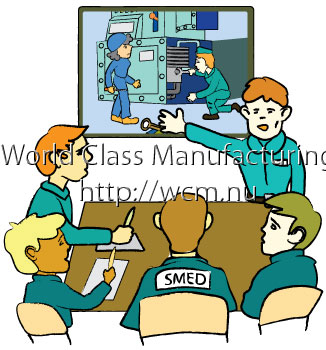
"SMED Video analysis "
Step 7 - Elimination of waste. Measures are carried out to reduce all types of waste. This includes:
Step 8 Follow up and improve. Make sure that your new level sets the new standard
Many use consultants for training in the SMED method. If you prefer a do-it-yourself alternative please consider our PowerPoint presentation complete with trainers manual and workshops. Follow this link for a free demo


Succeeding With Lean Leadership

Succeeding With 5S

Succeeding With Standardized Work