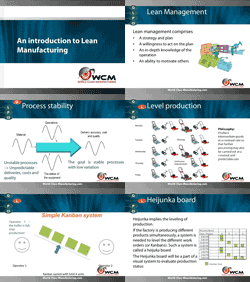

As you may know, "Lean" is a huge concept, with many different tools to use. Even worse, implementing the tools is not enough; you need to implement the right culture in your organization to achieve sustainable results.
I have developed these pages to help you. If you are new to this, start by taking the assessment. Not only will you measure your current status, but you will also have an action plan proposed for you.
Then you may want learn more from our articles. More than 20 articles covering many different aspects of the concept are waiting for you.
Soon it will be time to implement the tools and concepts; I have made different calculators to help you. The most popular are the OEE Calculator , the Kanban calculator, and the Takt time calculator.
Do you need to calculate the costs and benefits for your change program? Try the ROI – calculator.
"The Toyota Way can be briefly summarized through the two pillars that support it: Continuous improvement and Respect for people" (1)
Lean Manufacturing (also called Toyota Production System, TPS) is a production system inspired by the Japanese concept of kaizen (the strategy of continuous improvement).
Unlike Kaizen, Lean has a focus not only on quality control but also on quantity control to eliminate waste and reduce costs.
There are many definitions and viewpoints for the concept, but the main goal is to eliminate waste.
"Waste" refers especially to excess input materials and useless processing steps. The goal of "eliminating waste" may also be stated as providing exactly what the customer values for the lowest cost of production. This will maximize profit per unit.
The word "Lean" implies "cutting the fat" or "trimming waste", where "fat" or "waste" refer to whatever is not valued by the customer. So another way of expressing the goal is to only use materials and processes that add value for the customer.
What is "value for the customer"?
Here is a simple example of what is "valued by the customer". Let's say that you need a supply of nuts and bolts for an assembly operation, so you are the customer for the bolts. You need the size to be correct, but these bolts do not need to be plated or rust-proof or special in any other ways. Therefore nickel plating does not add value to you as a customer, even though it makes a better bolt in other applications.
Further, let's say you need a supply this afternoon or your factory will shut down. Therefore availability and quick delivery are very valuable to you. You might even pay a premium for express delivery of a one-day supply of already-expensive nickel-plated bolts, while negotiating a discount for a larger supply of standard bolts that your supplier can ship for delivery tomorrow.
In the above example, you, as the customer, place value on having the right size of bolt and timely delivery, but not on nickel plating.
Three Japanese words defined "waste":
The original development of the concept listed seven types of muda waste. More have been added since then:
The vision is to reduce batch size to "one" as a way of reducing waste:.
Value Stream Mapping is a process that follows the manufacturing process to determine which process adds what type of value to the product. In the above example where you need a supply of bolts today, value was added by the milling operations (to cut and thread the bolt) and also by the expedited shipping process. The nickel-plating step added no value. If you had placed your order with enough lead time for regular delivery, then the expedited delivery service would have added no value.
Value Stream Mapping entails following the manufacturing process, including the handling and storage stages, to determine where value is added. For example, storing goods-in-process so that a coating can dry properly is a value-adding step (if the customer wants the coating). Storing finished goods in a warehouse in order to expedite shipping might add value, depending on the time to manufacture and the urgency of a customer's order. (In the airline industry, for example, "Plane on Ground" is the highest priority for manufacturing a replacement part). Storing goods-in-process in a warehouse (because the next machine is busy working on previous batches) does not add value.
References
1. Jeffrey Liker, The Toyota Way
2. Lonnie Wilson, How To Implement Lean Manufacturing
By Oskar Olofsson


Succeeding With Lean Leadership

Succeeding With 5S

Succeeding With Standardized Work